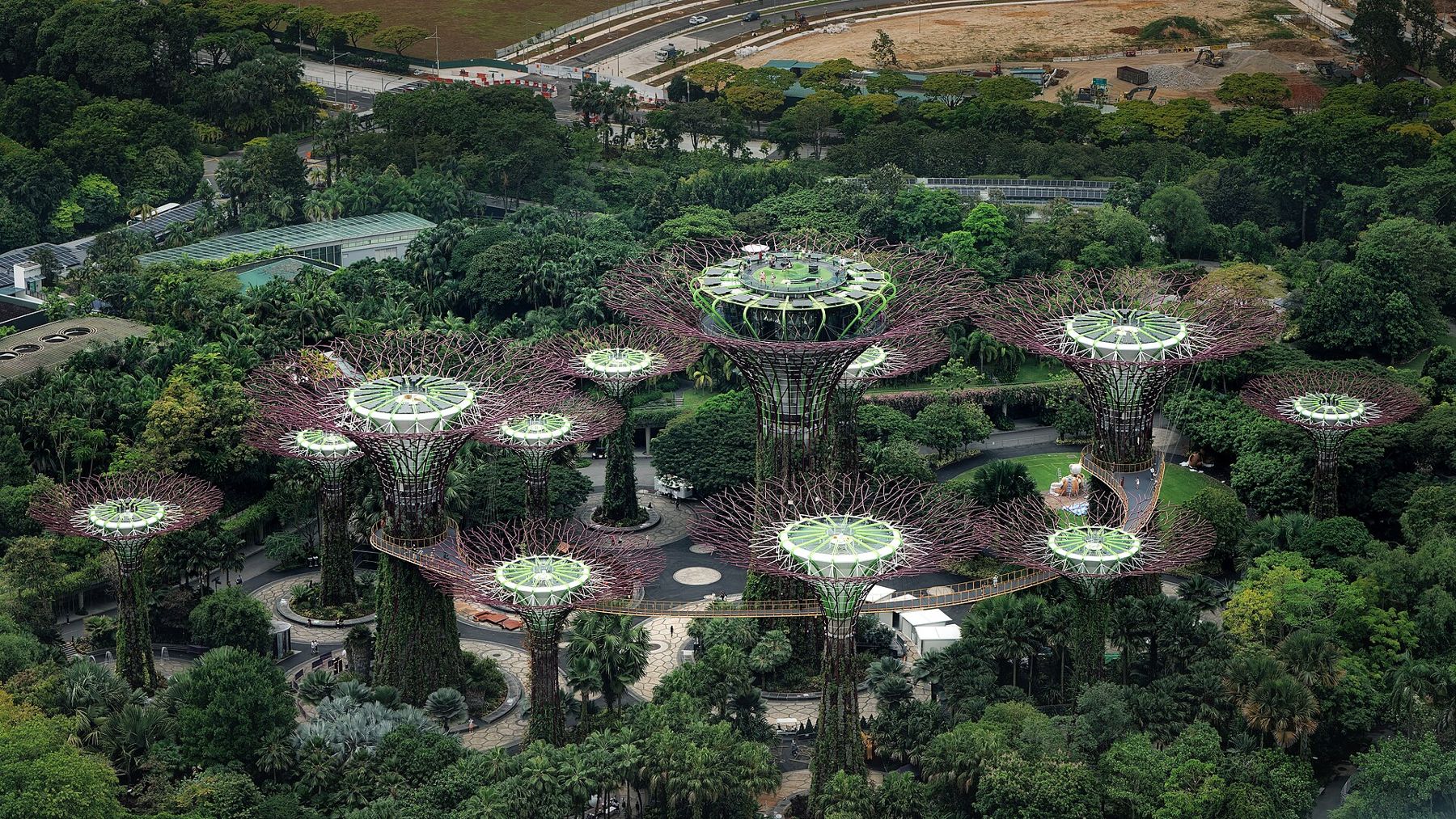
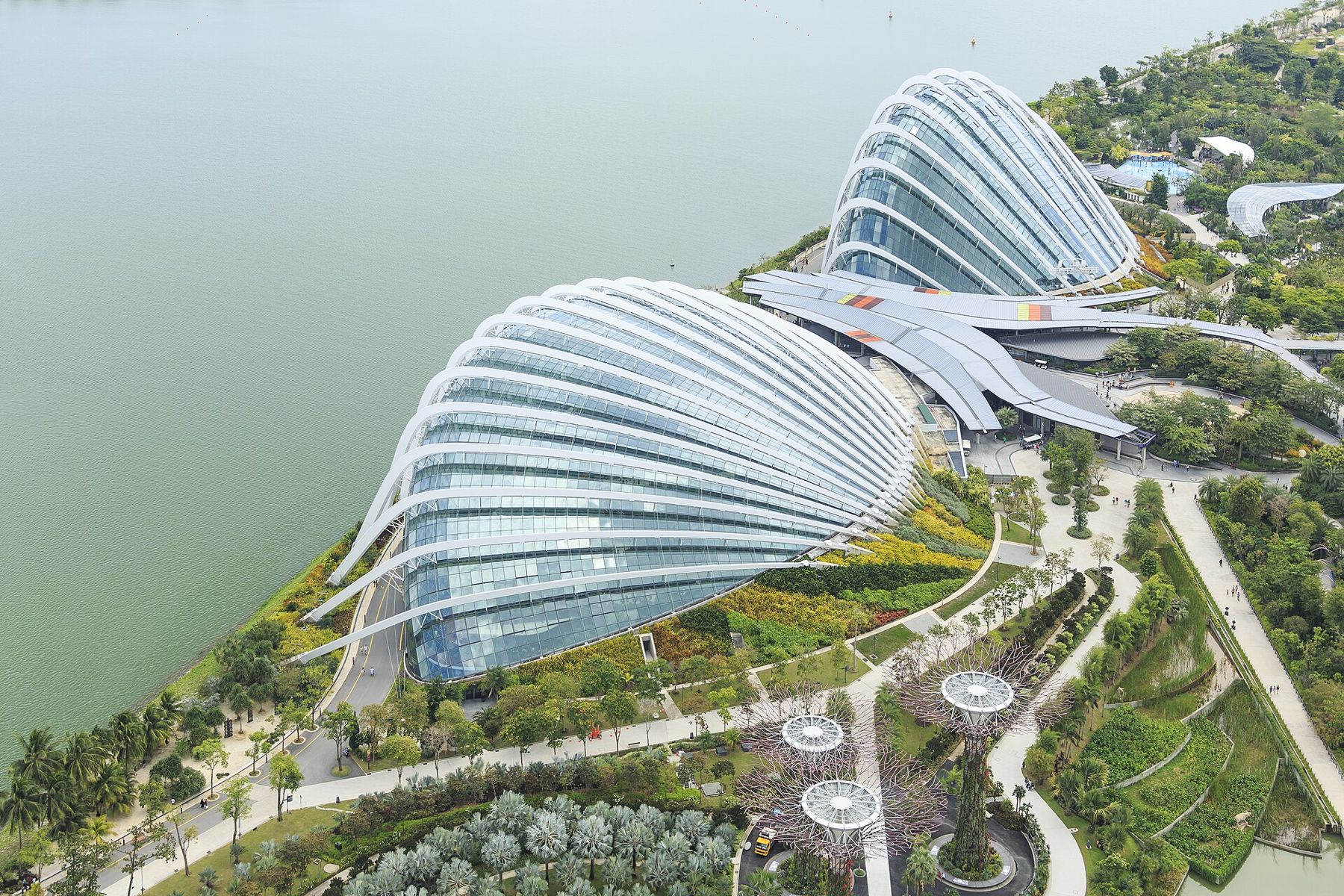
From the top of Marina Bay Sands, Gardens by the Bay looks like a circuit board someone has planted. Paths curve between lakes, two glass conservatories lie on the shore like stranded shells, and in the middle stands a grove of purple steel trees, their canopies spread like upturned umbrellas. At ground level it is less diagram and more weather: heat off the paths, wind off the sea, and the steady hiss of misting sprays in the borders.
The Gardens opened in 2012 on land that did not exist a few decades earlier. It was made by reclaiming the sea at the mouth of the bay, and the park was conceived as part of the plan to turn Singapore into a city in a garden rather than a city with gardens in it. There are three waterfront gardens; most visitors know only the largest, Bay South, beside Marina Bay Sands.
The Supertree Grove
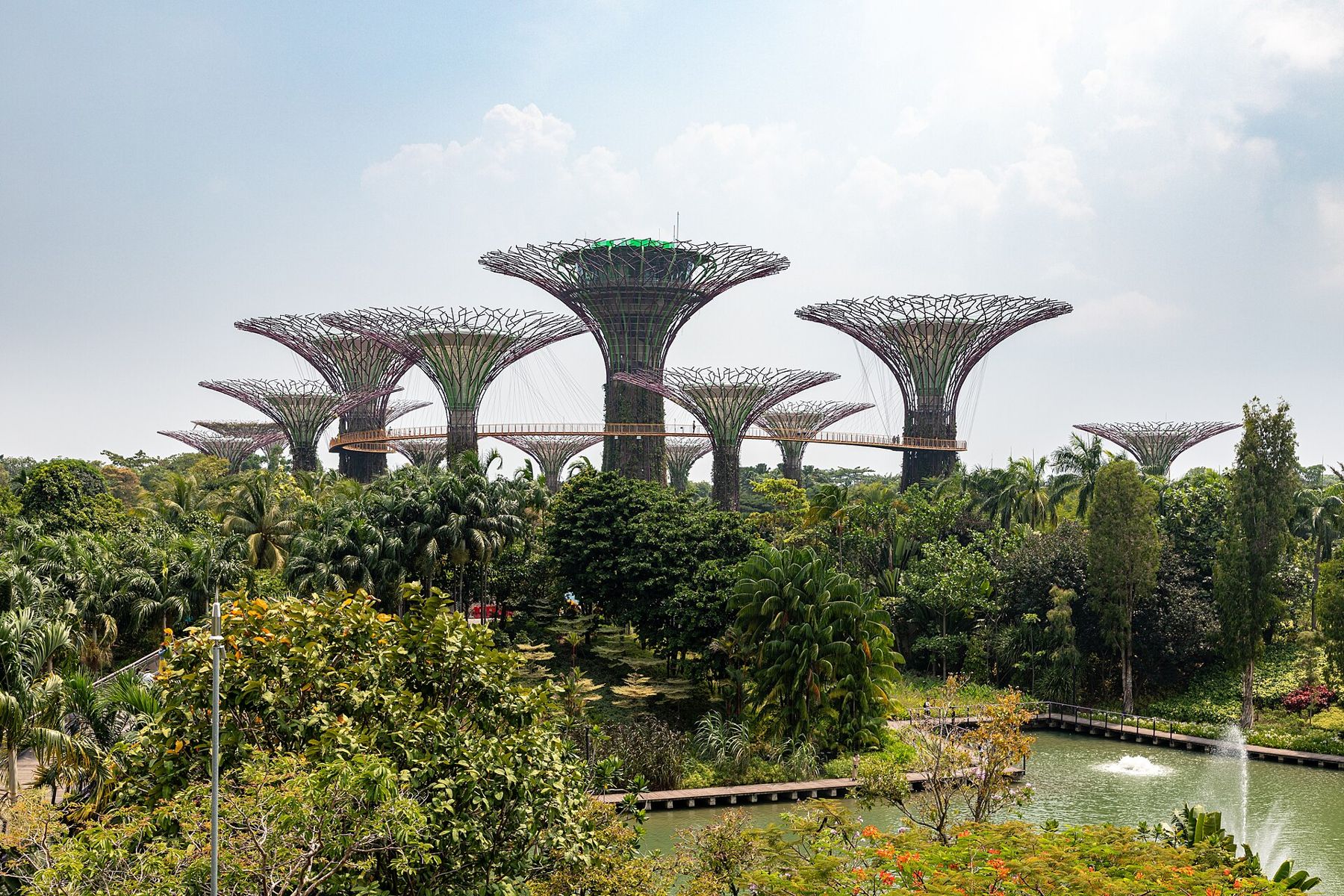
The Supertrees are the image everyone carries home. There are eighteen of them across the Gardens, the tallest roughly fifty metres, with trunks of steel latticework clad in living plants: ferns, orchids, bromeliads and climbers, planted into panels so that each tree becomes a vertical garden. Over the years the planting has thickened, and the trunks are now properly green and shaggy rather than skeletal.
They are not only decorative. Some carry solar panels in their canopies, and some act as chimneys for the systems that keep the conservatories cool. But the point, for the visitor, is scale and shade. Standing under the grove at noon, you get a sense of the forest canopy the design borrows from, even if the trees are made of steel.
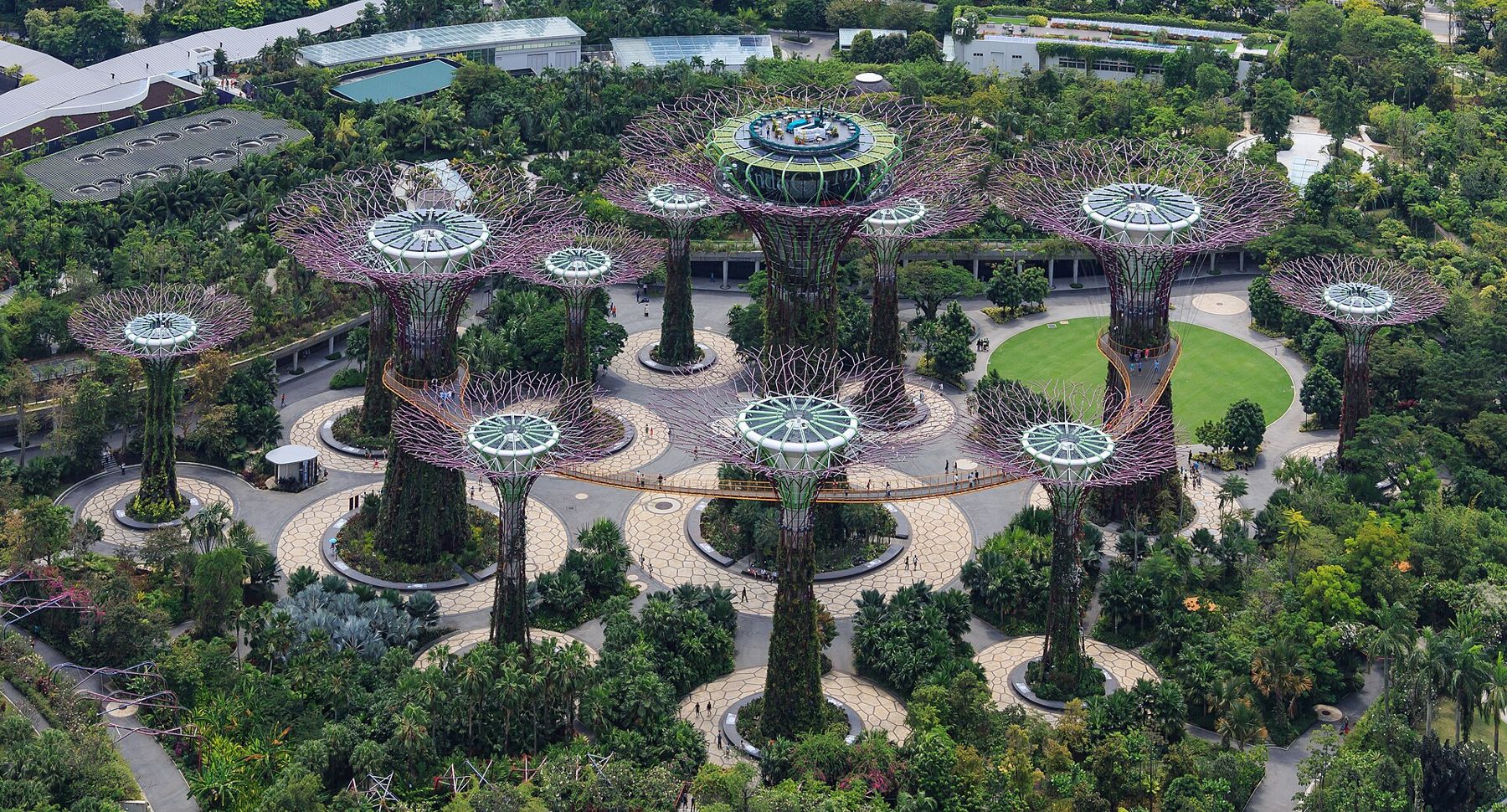
A walkway, the OCBC Skyway, links two of the Supertrees some twenty metres above the ground. It is ticketed and narrow, and it closes in bad weather. The view from it is less about height than about being among the canopies, with the conservatories on one side and the towers of the bay on the other. If heights bother you, the ground is a fine place to be.
Look closely at the trunks rather than up at the canopies. Each tree carries a different mix of plants, and the planting is denser and wilder than it seems from a distance: staghorn ferns the size of armchairs, orchids tucked into the steel, philodendrons dangling aerial roots like loose cables. Birds have noticed too. Sunbirds work the flowers, and in the early morning, before the crowds arrive, the grove is full of their thin, metallic calls.
Two glass domes, two climates
The conservatories are the reason many people buy a ticket. They are two vast glass structures, cooled and dehumidified, each recreating a climate that Singapore does not have.
The Flower Dome is the larger and lower of the two. Inside it is cool and dry, a Mediterranean and semi-arid world of olive trees, baobabs, succulents and a central flower field that changes with seasonal displays. Chinese New Year brings lanterns and chrysanthemums; other months bring tulips, roses or whatever the theme is. Some of the olive trees are very old, shipped in whole, their trunks twisted like rope.
The Cloud Forest is taller and stranger. You walk in and are met by a wall of falling water, an indoor waterfall tumbling some thirty metres down the face of an artificial mountain covered in ferns, mosses, orchids and pitcher plants. A lift takes you to the top, and walkways spiral down around the outside of the mountain, through mist and cool air. It recreates the tropical highlands, the cloud forests of mountains like Kinabalu in Borneo, and on a hot afternoon it is the most refreshing room in the country.
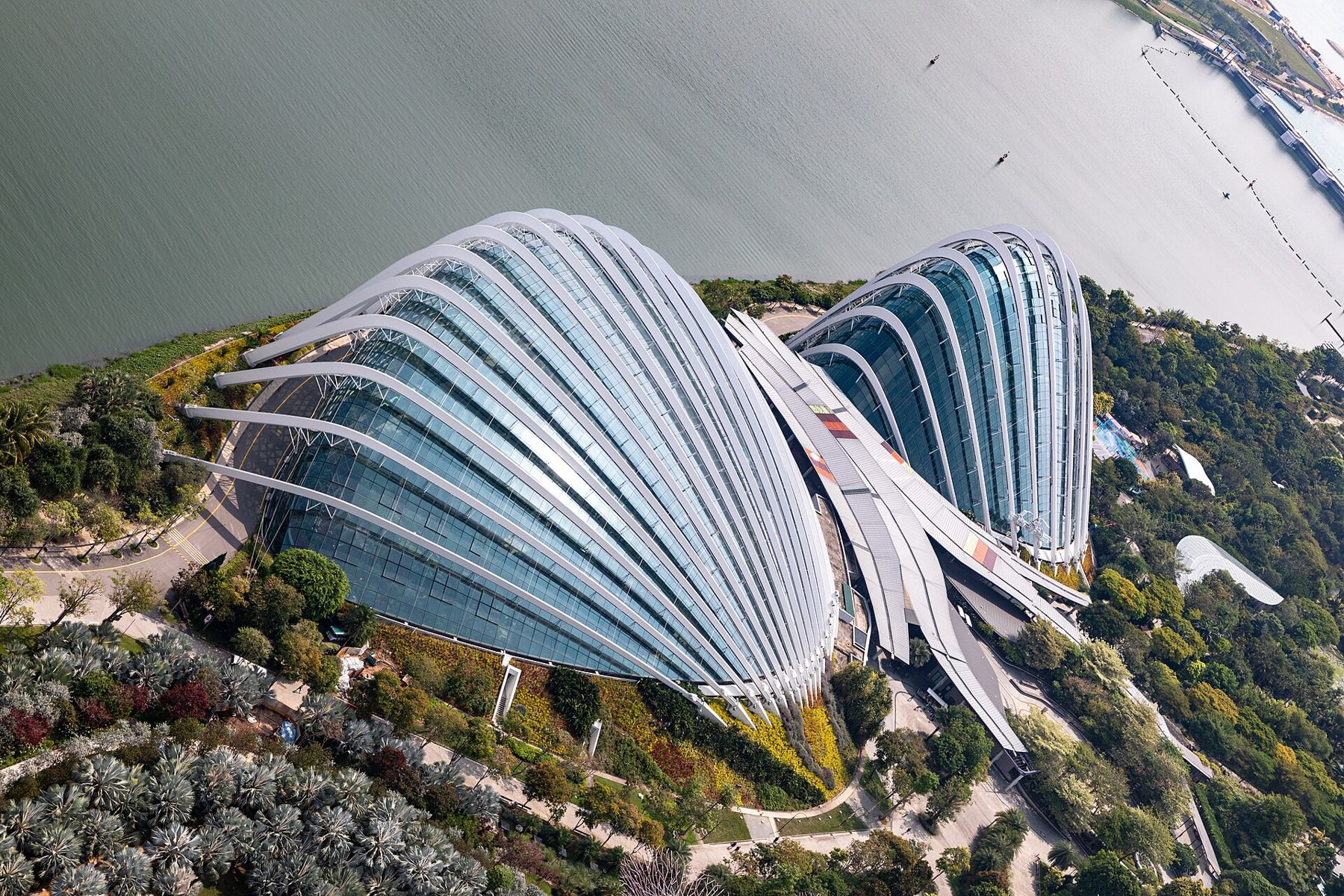
Both domes are ticketed, separately or together, and prices change. We would choose the Cloud Forest if you can only see one. Go early in the day or on a weekday to avoid the crowds that gather at the waterfall.
What is free
Much of the Gardens costs nothing, and the free parts are the better half for many visitors. The outdoor gardens are open to anyone from early morning until late at night. You can walk the Supertree Grove at ground level, the lakes and the heritage gardens without a ticket.
The heritage gardens are worth seeking out. They tell the story of the plants tied to Singapore's communities and its colonial history: an Indian garden laid out in a stylised flower pattern, a Chinese garden with its scholarly symbols, a Malay garden with the plants of the kampong, and a colonial garden of cash crops such as rubber, nutmeg and pepper. Dragonfly Lake and Kingfisher Lake, at the edges, are planted with water plants that help clean the run-off before it reaches the bay, and boardwalks run along them.
 Next stall overThe Botanic Gardens, where Singapore keeps its oldest green
Day or night
By day, the Gardens are a place to walk slowly in the heat and duck into the domes to cool off. By night, they become a show. Each evening the Supertrees light up for a free light and sound performance, Garden Rhapsody, with music played across the grove while the canopies change colour. Crowds gather and lie on the ground to watch, which is the right way to see it. Show times are posted by the Gardens and change from time to time, so check before you plan the evening around them.
The evening has another advantage: it is cooler. Many people time a visit to arrive in the late afternoon, see one conservatory before closing, wander the outdoor gardens as the light fades and stay for the light show. Afterwards it is a short walk back to Marina Bay Sands, or across to the waterfront promenade for the view of the skyline.
Bay East, the quieter side
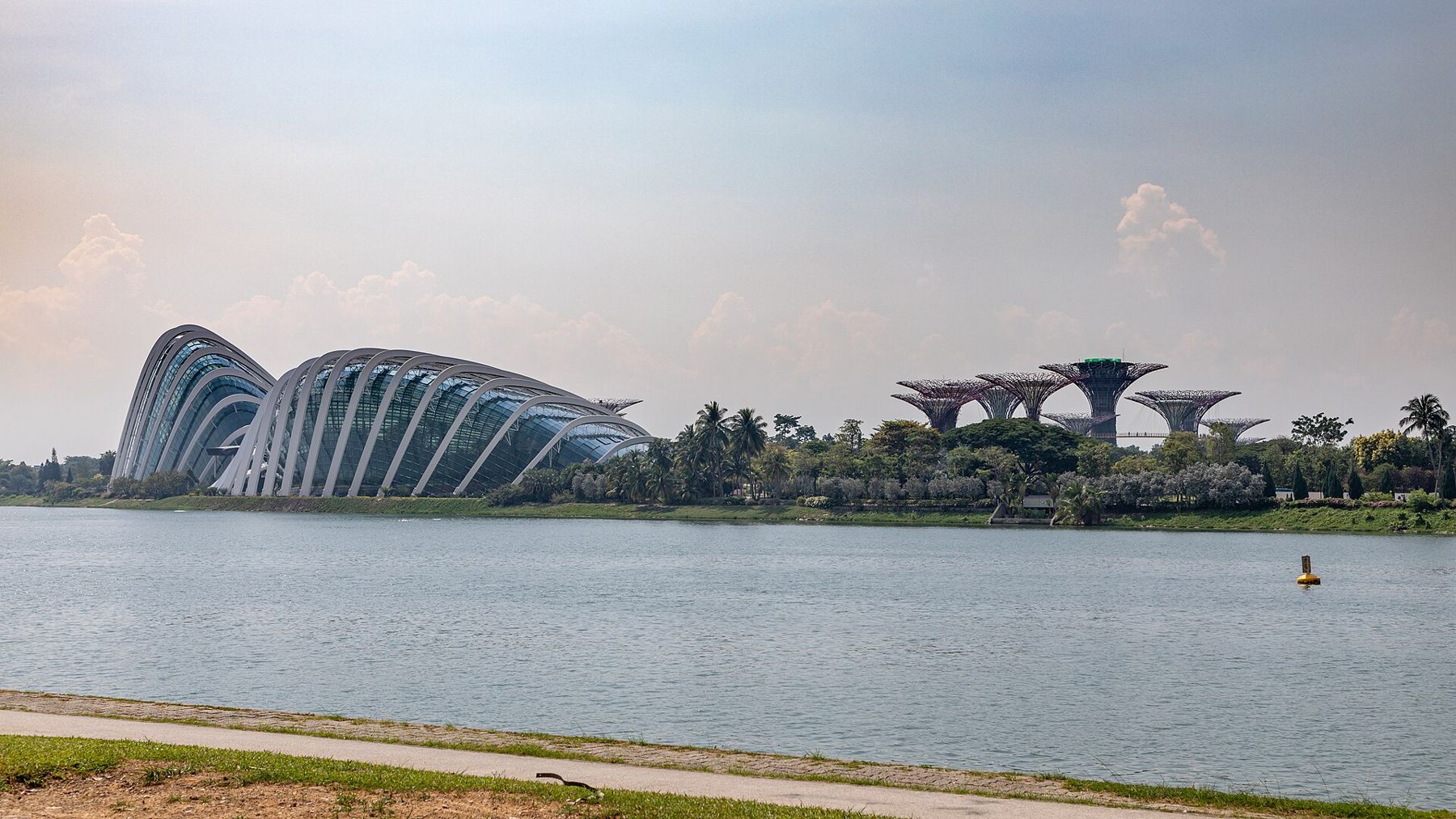
Across the water from the main gardens is Bay East Garden, which most visitors never reach. It is a long, open strip of lawns and palms along the waterfront, with fewer attractions and far fewer people. What it does have is the view: from its shore, you look back across the water at the city skyline, Marina Bay Sands and the Supertrees, which is the angle many photographers favour.
It is a good place to come in the late afternoon with a picnic and stay until dark. Getting there takes more effort, by bus, taxi or a long walk over the Marina Barrage, but the effort is part of its appeal. The barrage itself, a dam that turned the bay into a freshwater reservoir, has a grassy roof where families fly kites in the evening breeze.
Walking the whole loop, from Bay South across the barrage to Bay East and back along the far shore, is a long evening out, and best done once the sun is low. It shows how the parts of this reclaimed shore fit together: the gardens, the dam, the reservoir, and the city looking down on all of it.
Practical notes
The MRT is the easiest way in. Gardens by the Bay station on the Thomson-East Coast Line drops you near the main gardens, and Bayfront station, on the Circle and Downtown lines, connects through Marina Bay Sands and a bridge over the road. There is a hawker centre, Satay by the Bay, at the edge of the Gardens near the water, good for an evening meal under the trees.
The heat is the main thing to plan around. The paths are mostly open to the sun, and the asphalt holds heat well into the evening. Bring water, wear a hat, and use the conservatories as your air-conditioned breaks. In a thunderstorm, with lightning around, get indoors: the open lawns and the Skyway are no place to be when the weather turns, and outdoor attractions close when storms pass over.
Plan on half a day if you want to see both domes and the outdoor gardens properly, longer if you stay for the evening show. Tickets for the conservatories and the Skyway can be bought at the Gardens or online, and prices differ for residents and visitors.
The best moment may be the simplest one. Lie on the warm ground under the Supertrees as the evening show begins.
Lie on the warm ground under the Supertrees as the evening show begins.
The canopies above you fade from purple to blue to gold, the music swells across the grove, and the towers of the bay glow behind them. For ten or fifteen minutes, it is very hard to remember that the ground beneath you was once open sea.