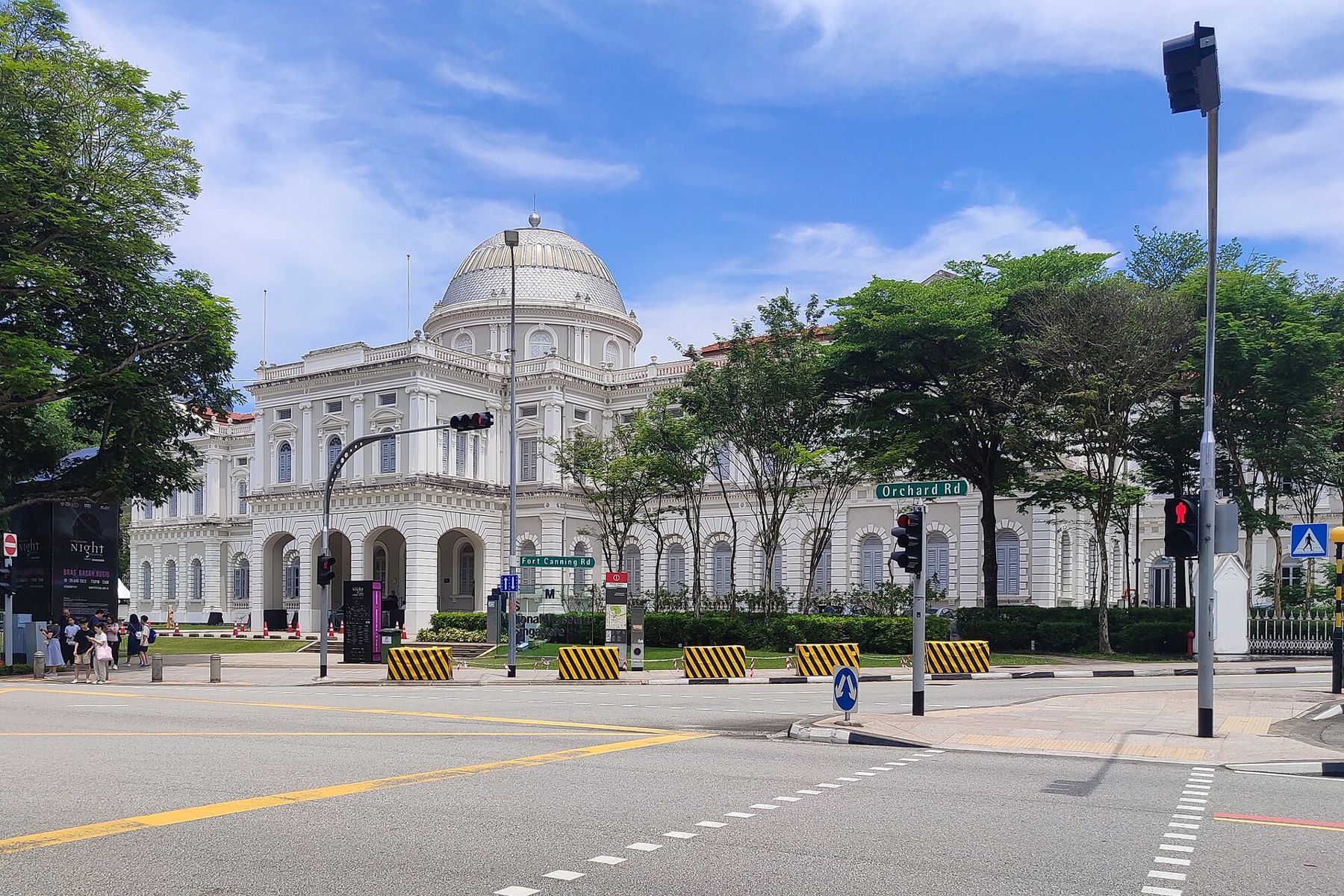
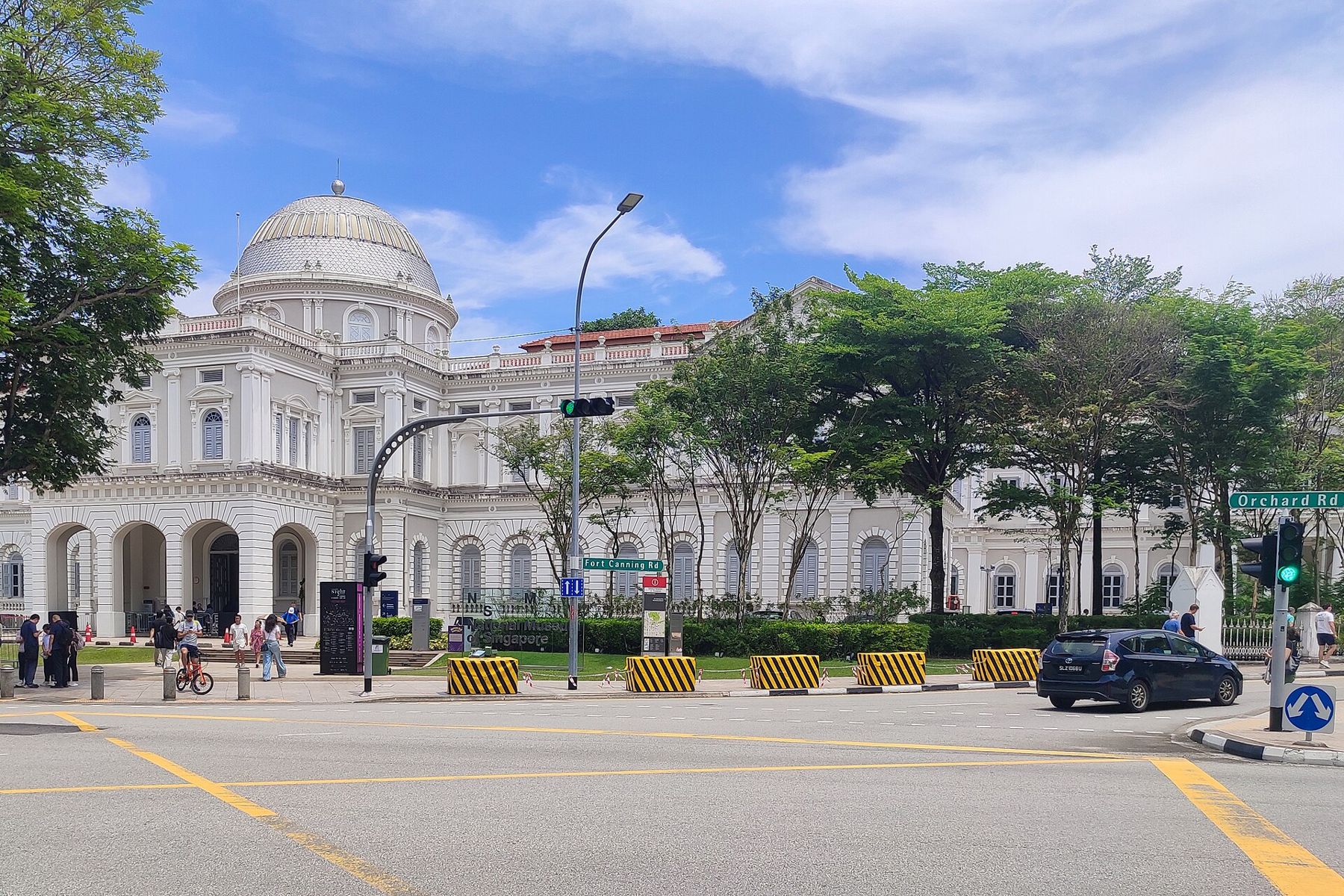
Stand on Stamford Road and look up. The dome of the National Museum rises above a white Palladian front, and behind it the trees of Fort Canning climb the hill. In the afternoon the light comes through the stained glass under that dome and lays coloured patches on the floor of the rotunda. It is one of the oldest public interiors in Singapore, and it has been doing that since the 1880s.
The museum is the oldest on the island. Its collection began in 1849 as a library and museum attached to the Singapore Institution, the school that grew from Raffles's plans, and moved into its own building on Stamford Road in 1887 as the Raffles Library and Museum. Since then it has changed its name and its purpose more than once, from a colonial collection of natural history to a museum of the nation, but the building has stayed, and so has the idea that the story of the place should be told one room after another, under that dome.
A dome on Stamford Road
The building came out of the colonial Public Works Department, with the colonial engineer Henry McCallum credited with its design, in the neo-Palladian manner the British used for public buildings across their empire. It has a symmetrical front, a projecting portico and a central rotunda under the dome. Inside, the rotunda is ringed by columns and lit from above through stained glass, which was taken down and restored when the museum was renewed.
For most of its first century this was a museum of the natural history and ethnography of the Malay world, with cabinets of butterflies, birds, shells and skeletons, and the library sharing the building. The library moved to its own building next door in 1960. The natural history collection later went to the university and is now at the Lee Kong Chian Natural History Museum. The museum, renamed and repurposed, began to tell the story of Singapore itself.
The war years are part of the building's own story. During the Japanese occupation the museum and its library were kept going under a new name, and the collections survived largely intact, thanks in part to scientists on both sides who agreed that books and specimens should not be lost to the fighting. It is a small, humane episode in a hard time, and the museum tells it without fuss.
The building was gazetted as a national monument in 1992. It closed in 2003 for restoration and extension, and reopened in December 2006 with a new wing of glass and steel behind the old one.
The glass rotunda and the walk into history
The extension is a careful piece of work. It does not try to imitate the old building; it sits behind it, lower and transparent, so the dome is still the thing you see from the street. The two are joined by a glass link, and at its heart is the Glass Rotunda, a drum of glass with a ramp that spirals down inside it.
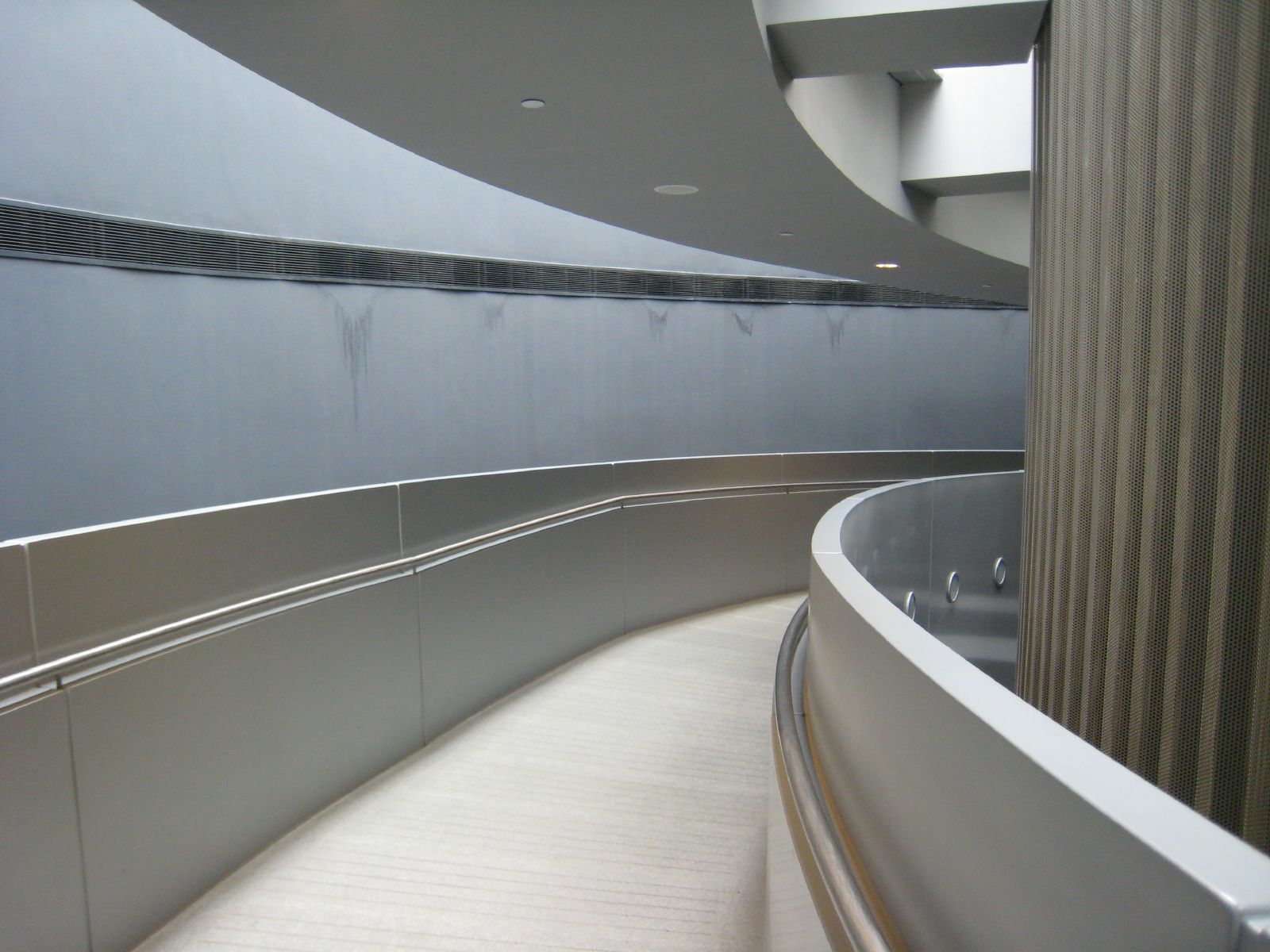
That ramp has long been the way into the Singapore History Gallery, and the descent works as a prologue. You walk down, out of the present, and arrive at the beginning of the story. The rotunda has also held large installations, including a digital forest drawn from the natural history paintings that William Farquhar, the first Resident of Singapore, commissioned in Malacca and Singapore in the early nineteenth century. The original Farquhar drawings, bold and exact studies of the animals and plants of the Malay peninsula, are one of the museum's great collections, and a selection is usually on show.
You walk down, out of the present, and arrive at the beginning of the story.
What the history gallery tells
The history gallery runs in order, from the fourteenth century to the present day, and it is the core of any visit. It begins with Temasek, the trading port that stood at the mouth of the Singapore River and on the slopes of Fort Canning in the 1300s, when Chinese ceramics, Indian Ocean beads and coins from across the region passed through it. Here is the Singapore Stone, a fragment of a large inscribed sandstone boulder that once stood at the river mouth and was blown up in 1843 to widen the passage into the river. Its script has never been fully read. Nearby are gold ornaments found on Fort Canning Hill in 1928, among them an armlet with the head of a kala, a protective face from Javanese art.
Then come the quieter centuries, the arrival of Raffles and Farquhar in 1819, and the long colonial period, when Singapore grew into a port of migrants. The gallery is good at showing how ordinary people lived: the shophouse and the coolie lodging, the opium trade and the rickshaw, the schools and the clan associations, and the Malay, Chinese, Indian, Eurasian and other communities who each built a part of the town.
 Next stall overThe colonial core, building by building, from the Padang to Raffles Hotel
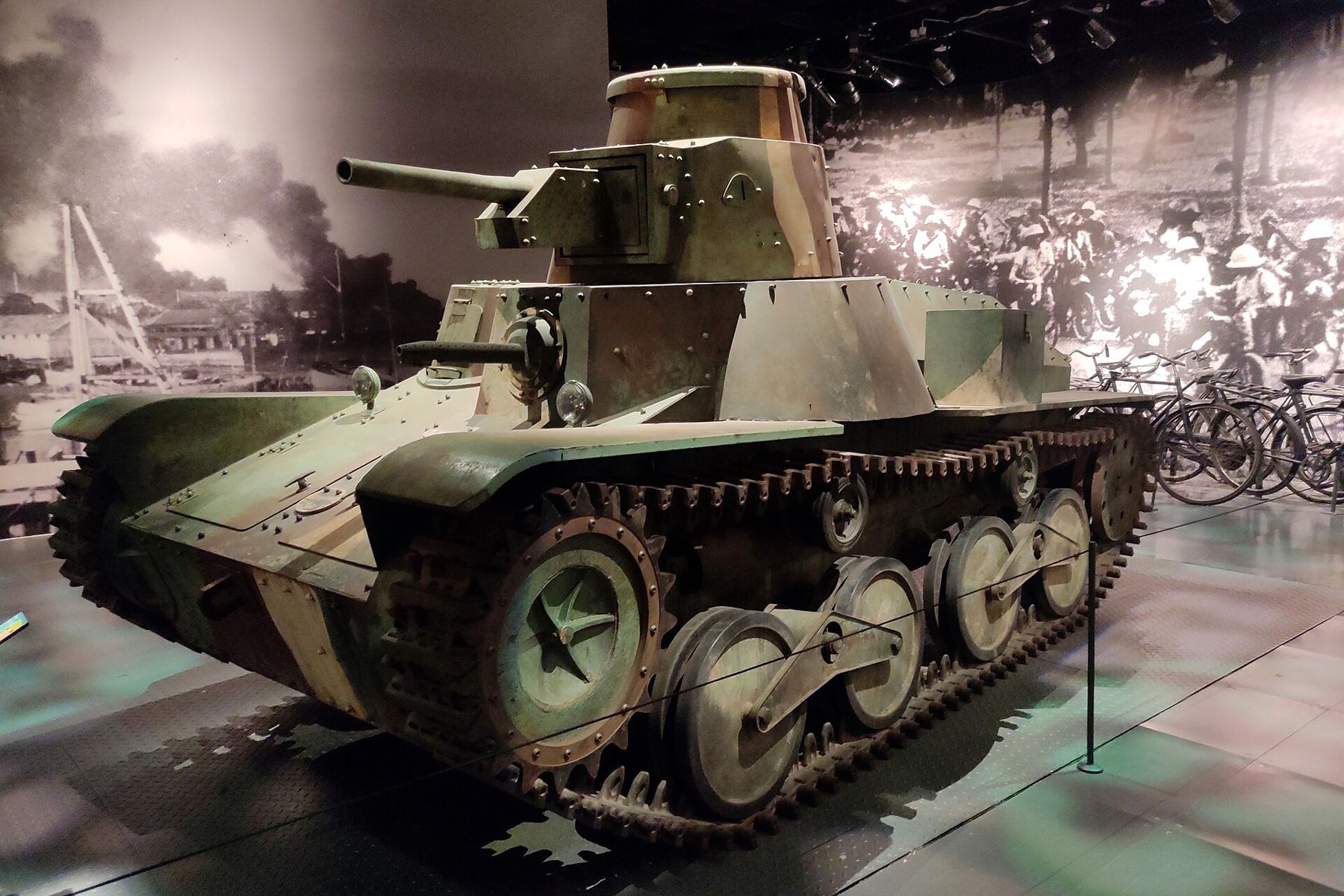
The Japanese occupation from 1942 to 1945 is told plainly and at length. There are personal objects, recorded testimony and the hard facts of the Sook Ching screenings, in which the Japanese military police killed large numbers of Chinese men in the first weeks of the occupation. A replica of a Japanese light tank stands in this part of the gallery, small enough to be shocking when you consider what it was built for.
The final sections cover the years after the war: strikes and riots, self-government in 1959, merger with Malaysia in 1963, separation and independence in 1965, and the building of the new state. The tone is factual and the objects carry most of the weight: ballot boxes, campaign posters, early passports, the furniture of the first public housing flats.
Life in Singapore, and the rest of the building
Upstairs, a set of smaller galleries looks at daily life across the twentieth century through themes such as food, film, fashion and photography. These change more often than the history gallery, and the museum also runs temporary exhibitions in its basement and in the old building. It is worth checking what is on, because the shows are often excellent and sometimes the reason to go.
A good way to use these rooms is to pick one theme and stay with it. The food gallery, when it is on, tends to be the favourite with visitors who have spent the morning in a hawker centre, because it explains where many of the dishes came from and how the stalls ended up in the centres. The film and photography rooms are quieter, and full of faces from the streets you will have walked: Chinatown in the 1950s, the waterfront before reclamation, the first housing estates going up in what was then countryside.
Do not skip the old building itself. The rotunda, the staircases and the long galleries with their tall windows are part of the experience, and on a hot afternoon the high ceilings feel like the work of builders who understood the climate. There is a café and a shop, and the forecourt lawns are a quiet place to sit.
Fort Canning beside it
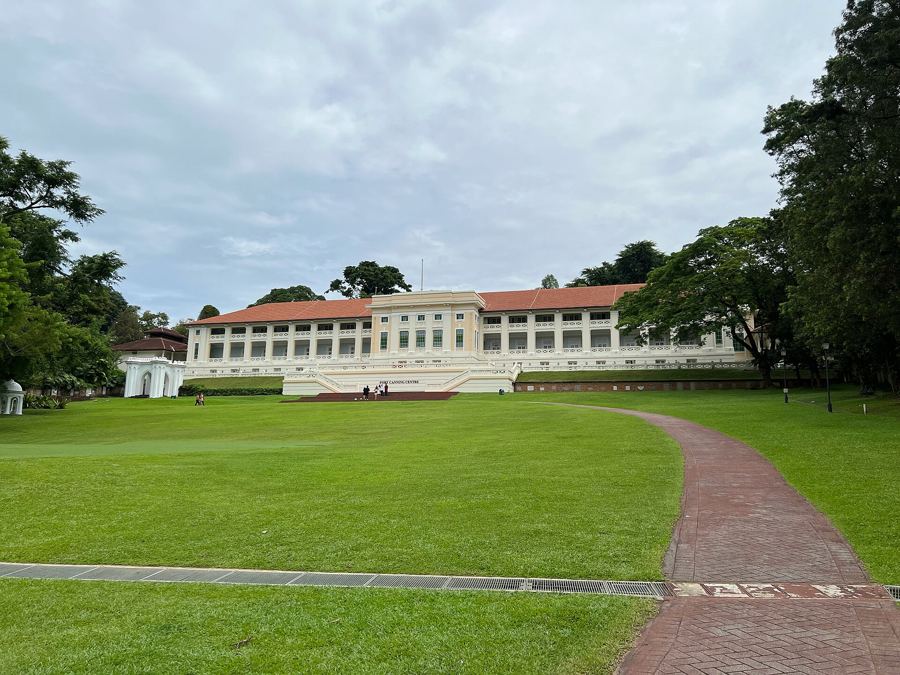
The museum's location is part of its argument. Behind it, Fort Canning Hill is where the fourteenth-century rulers had their palace, where Raffles built his house and his first experimental garden, and where the British commanders took the decision to surrender in February 1942. Paths climb into the park from just behind the museum, so you can step from the gallery to the ground where some of its objects were found.
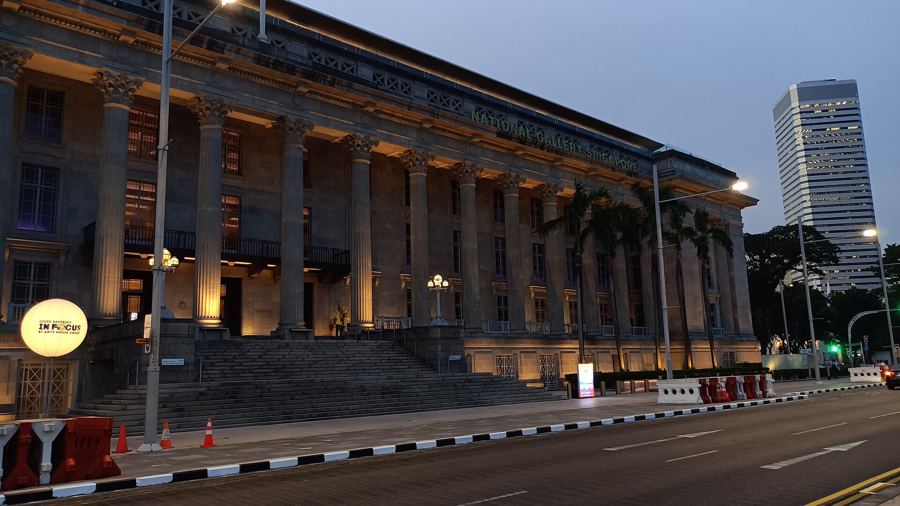
Across Stamford Road and up Armenian Street is the Peranakan Museum, and a short walk south brings you to the Padang and the National Gallery. A full day could take in all three, though two museums in one day is enough for most people.
Making the most of a visit
Come in the morning, when the galleries are calm and school groups have not yet arrived, and give the history gallery at least two hours. Prices, free-entry days and opening hours change, so check them before you go. Bags can be left at the cloakroom, and the building has lifts between floors.
If time is short, walk down the ramp of the rotunda, see the Singapore Stone and the Farquhar drawings, and finish under the dome of the old building, where the stained glass throws its colours on the floor much as it did when the doors first opened in 1887.