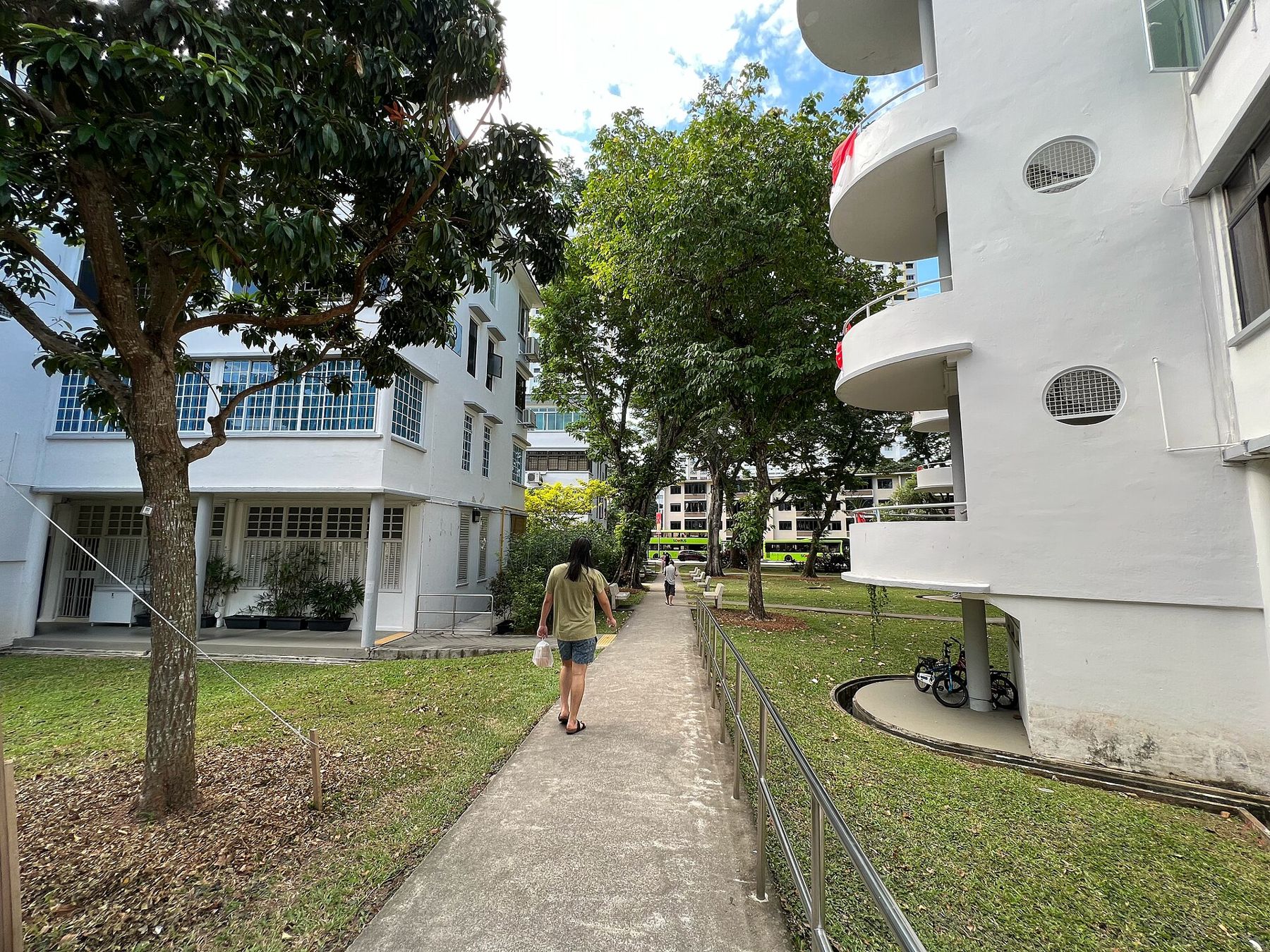
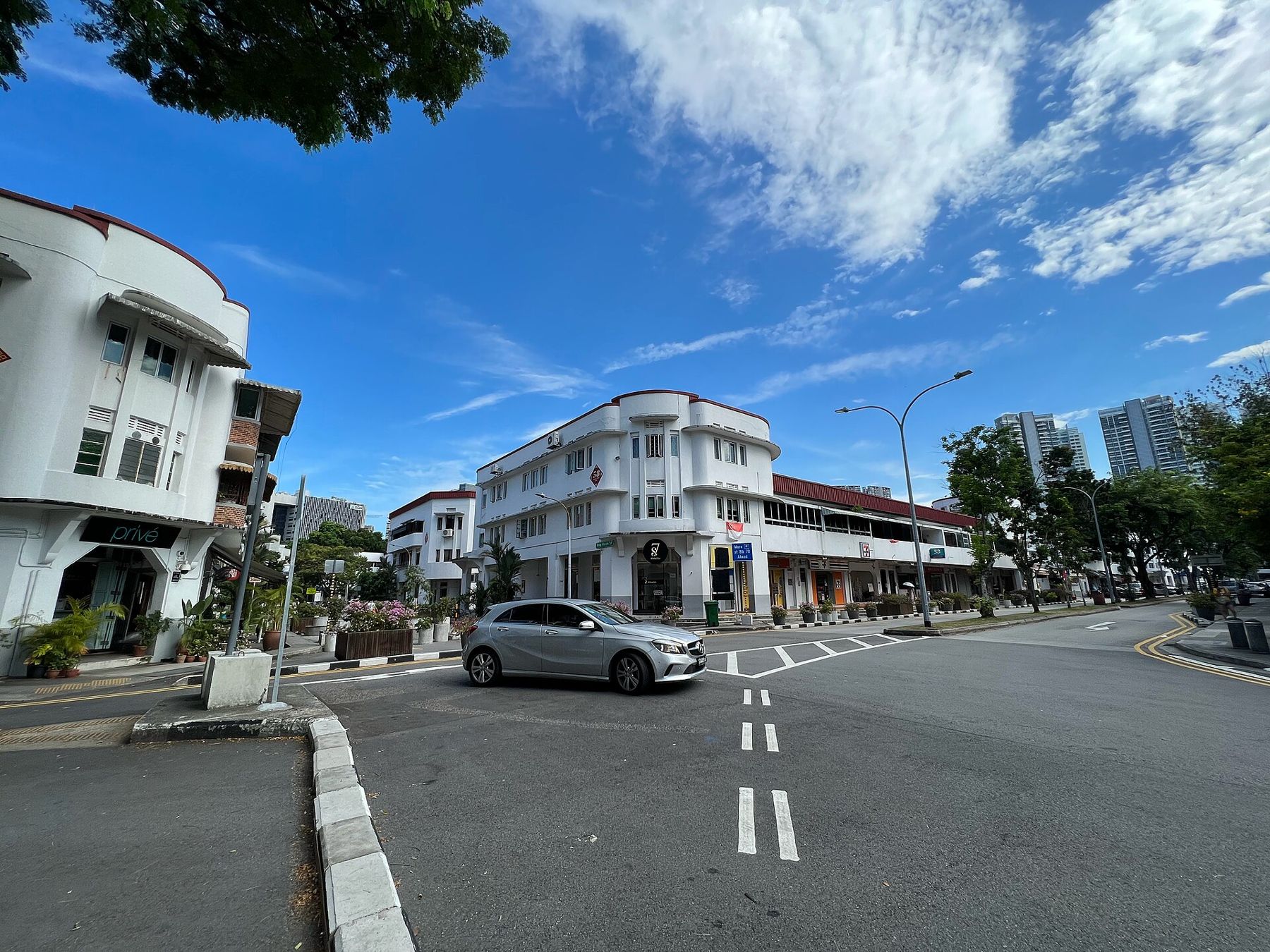
Walk into Tiong Bahru from the main road and the city seems to lower its voice. The buildings are three and four storeys high, painted white, with long horizontal lines and rounded corners like the bows of ships. Balconies curve around the ends of the blocks. At the back, spiral staircases twist up the walls to every flat. Old men sit in the shade at the foot of the blocks, a cat sleeps on a motorbike seat, and somewhere a radio plays Hokkien opera.
Tiong Bahru was the first large public housing estate in Singapore, and it is one of the finest groups of Art Deco buildings in Southeast Asia. Today it is also a fashionable neighbourhood of cafés and bakeries. Both things are true, and the pleasure of a visit is in seeing how they fit together.
A new cemetery, and a new idea
The name is usually explained as a mix of Hokkien and Malay: tiong, a cemetery, and bahru, new. Before the estate was built, this was low, swampy ground on the edge of town, with Chinese burial grounds, squatter huts and market gardens. In the early twentieth century Singapore's central districts were among the most crowded in the world, with whole families living in cubicles in subdivided shophouses, and the colonial government came under pressure to act.
Its answer was the Singapore Improvement Trust, set up in 1927 to improve the town and provide housing. The Trust cleared and drained the land at Tiong Bahru and began building in 1936. The flats were modern for their time, with their own kitchens and bathrooms, and they were meant for the clerks, shopkeepers and other middle-income families of the town.
Streamline and Art Deco
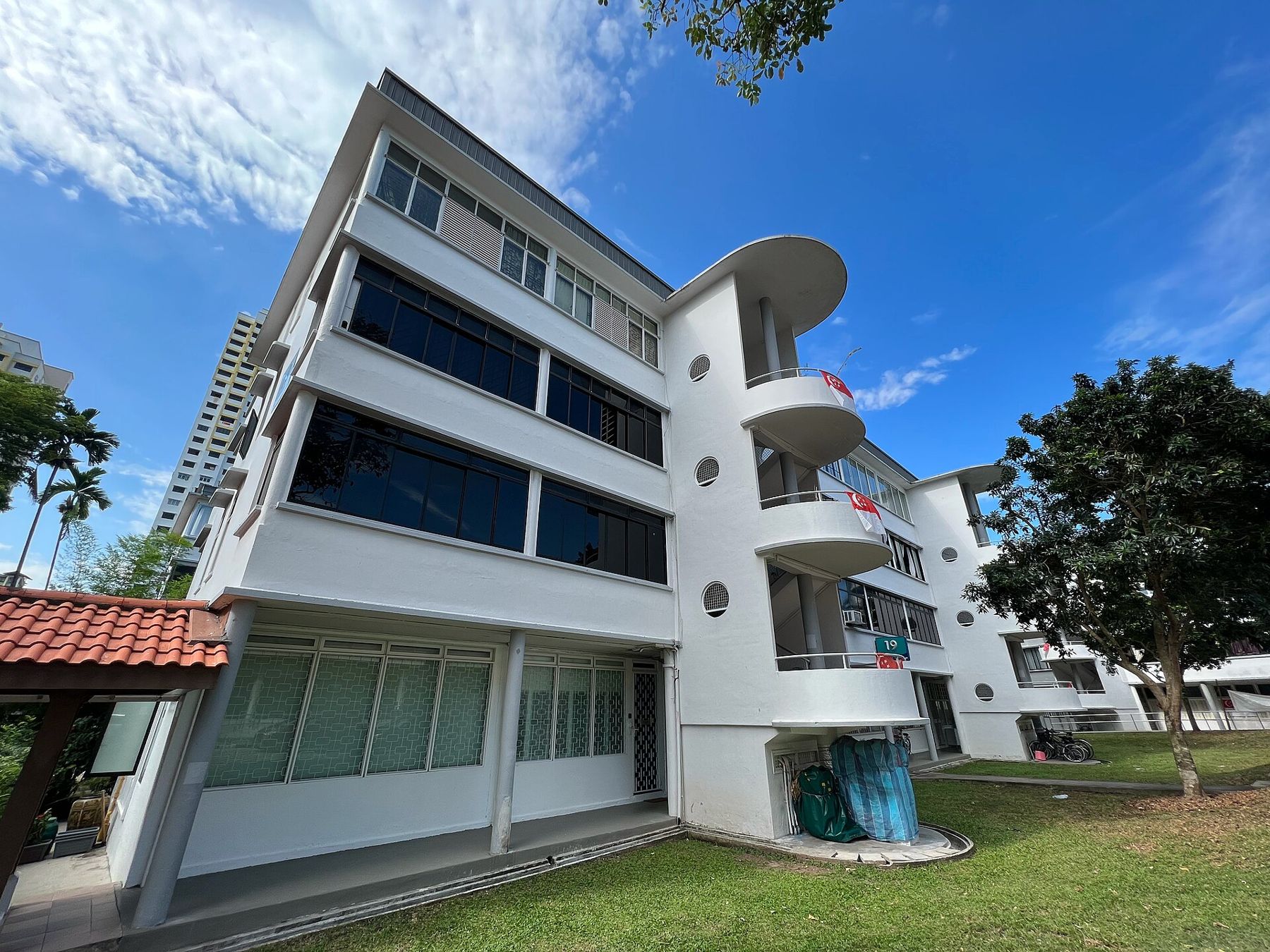
The blocks built before the war are in a style often called Streamline Moderne, a late form of Art Deco inspired by ships, aeroplanes and trains. Look for the rounded corners, the horizontal bands of windows and ledges, the curved balconies and the flat roofs. The buildings were planned around light wells and courtyards to bring air and light into the flats, and the back lanes are lined with the spiral service stairs that make the estate so recognisable.
Blocks went up through the late 1930s, and building resumed after the war, between 1948 and the mid-1950s, in a slightly plainer style. Together the pre-war and post-war blocks make up the old estate, a grid of low buildings on streets named after Chinese pioneers and philanthropists of the nineteenth and early twentieth centuries, among them Tan Chay Yan, a pioneer of rubber planting in Malaya.
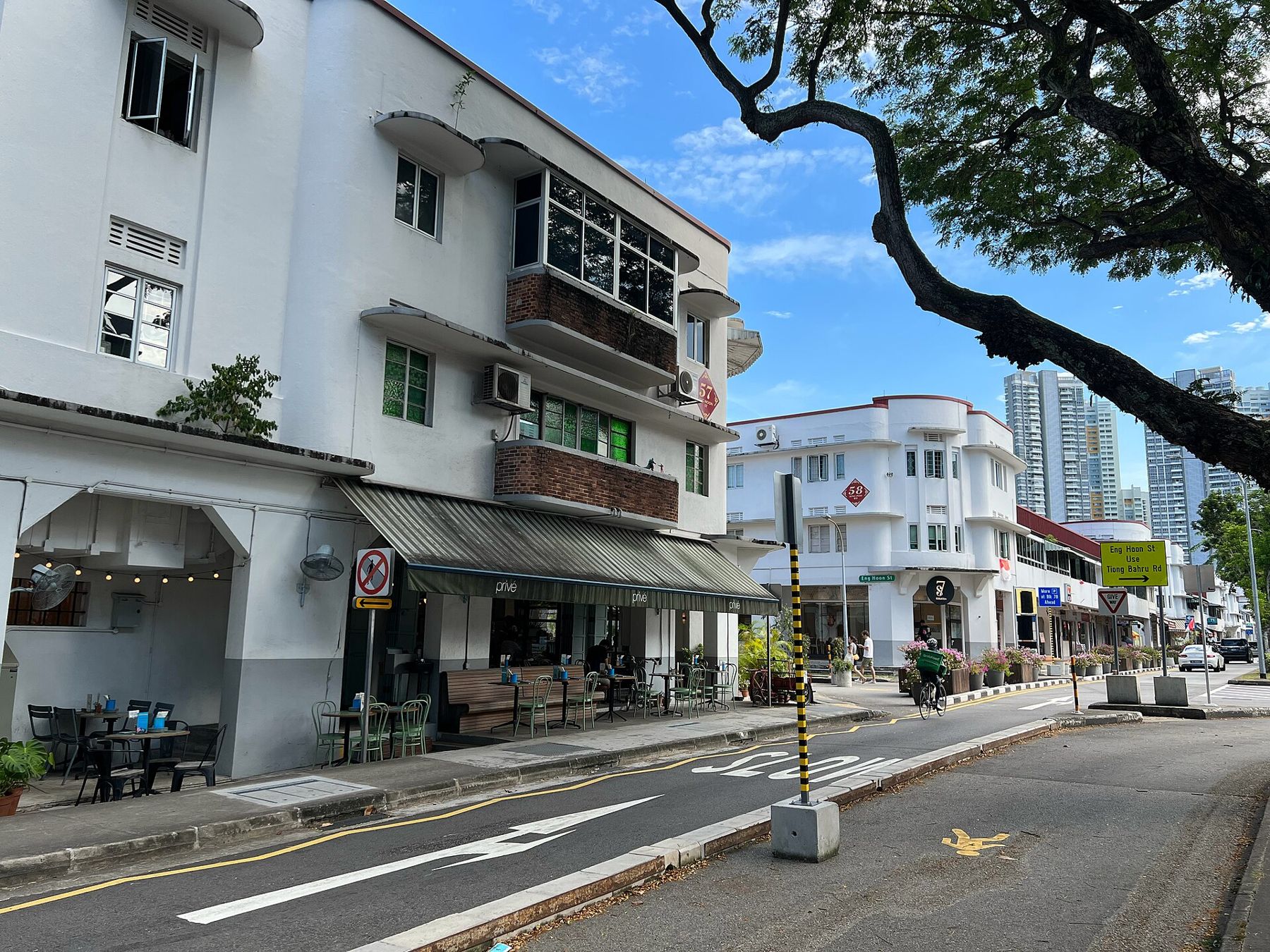
Inside, the flats are simple and generous by the standards of the day: a few rooms opening off one another, high ceilings, windows on more than one side for cross-ventilation, and a kitchen and bathroom at the back reached from the service stairs. Some of the ground-floor units were planned as shops from the start, with five-foot ways in front, so the estate had its own provision stores, coffee shops and barbers within a few steps of every door. That mix of homes above and shops below, borrowed from the shophouse, is one reason the estate still feels like a neighbourhood rather than a housing scheme.
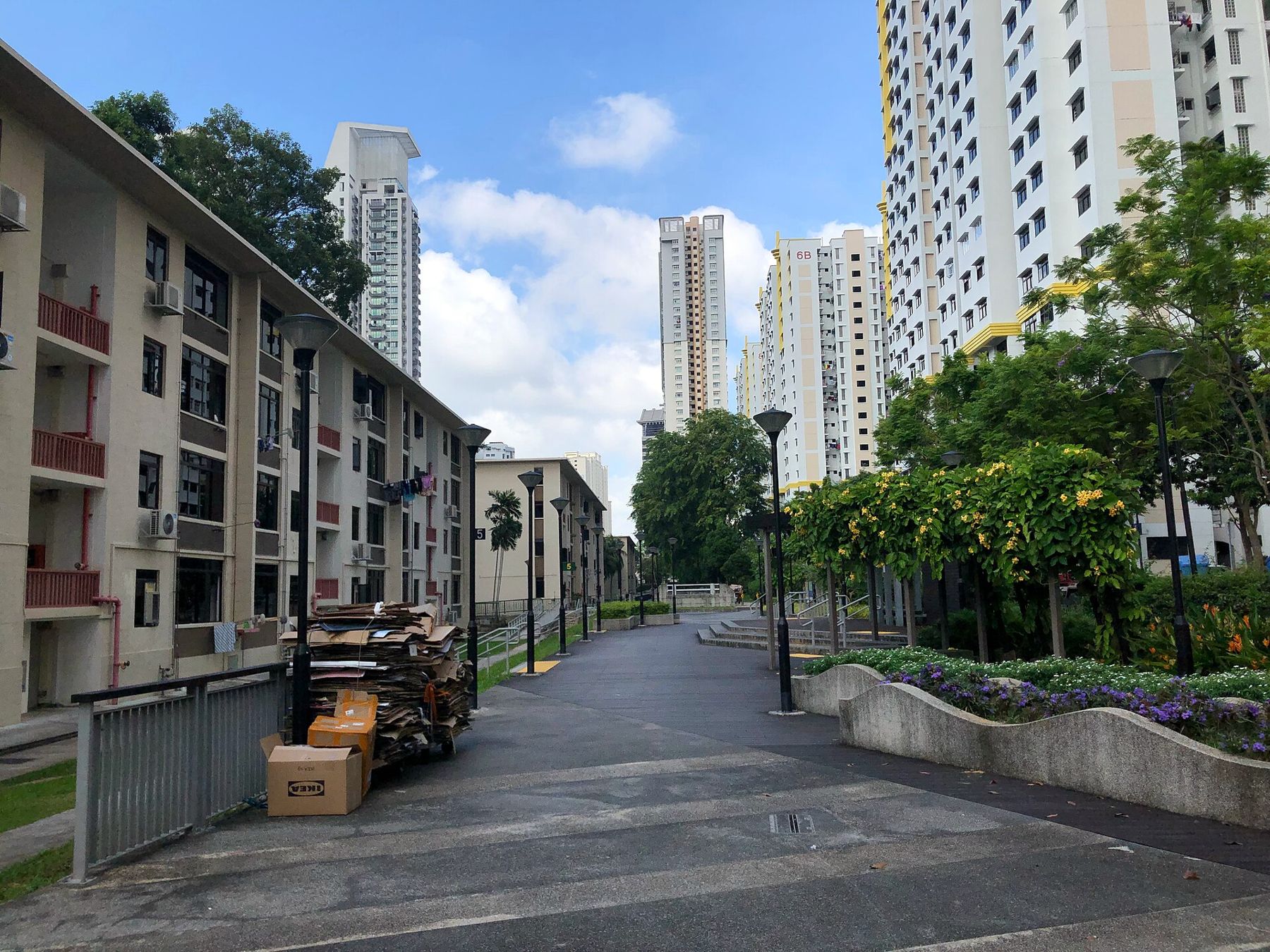
After independence, the Housing and Development Board, which replaced the Trust in 1960, built on a far larger scale, and the high-rise estates that now house most Singaporeans owe more to the urgency of the 1960s than to the gentle scale of Tiong Bahru. Walking here, you see the road not taken: low blocks, wide streets, trees, and a pace of life set by people on foot.
In 2003 the pre-war blocks were gazetted for conservation, and the estate as a whole has been protected from the redevelopment that replaced most of its contemporaries. Shophouses tell the story of the old town; Tiong Bahru tells the story of how the town first tried to house its people in something new.
Tiong Bahru tells the story of how the town first tried to house its people in something new.
The market and food centre
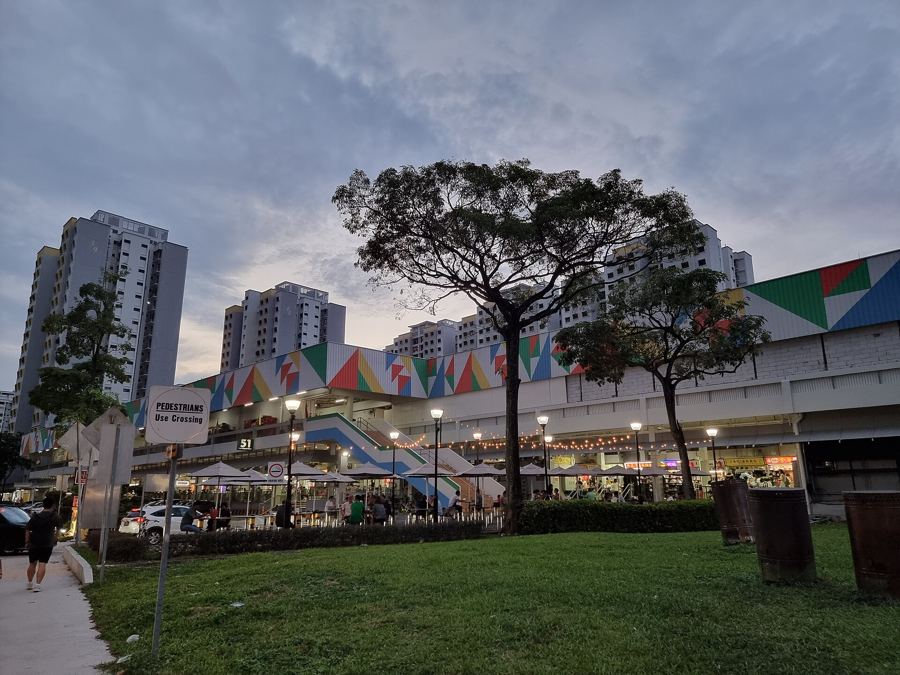
At the heart of the estate is Tiong Bahru Market, on Seng Poh Road. A market has stood here since the 1950s; the present building replaced it and reopened in 2006, with a wet market on the ground floor and a food centre on the floor above. In the morning, the ground floor is busy with residents buying fish, vegetables, flowers and tofu, and upstairs the food centre fills with breakfast crowds.
The food centre has a strong reputation, and many of its hawkers have been cooking for decades. Look for the local breakfast dishes: chwee kueh, steamed rice cakes topped with preserved radish; lor mee; porridge; and kopi from the coffee stall. Lunchtime queues form early for the best-known dishes. Prices change, so do not rely on any figure you read. How hawker centres work explains the trays, the queues and the tissue packets on tables.
 Next stall overEight hawker centres worth crossing town for
Bakeries, bookshops and the new Tiong Bahru
From the 2000s, younger residents and small businesses began to move into the estate, and the ground floors of the old blocks filled with cafés, bakeries, independent bookshops, design and lifestyle shops. Tiong Bahru became one of the city's favourite places for weekend brunch, and the queues outside the bakeries on a Saturday morning can be long.
The change has not been without tension. Some long-time residents miss the old provision shops and coffee shops; others welcome the life the newcomers have brought. Visitors can help by keeping their voices down in the residential lanes, not blocking the stairs and corridors for photographs, and remembering that these are people's homes. Most of the flats are still lived in, many by families who have been here for generations.
Stories in the lanes
The estate has its own lore. In the years before the war, local gossip held that some of the flats were home to the mistresses of wealthy men, and the area was given a nickname in Chinese that means, roughly, a nest of beauties. Whether it was true, the name stuck in the memories of older residents.
Under Block 78 on Guan Chuan Street is one of the few public air-raid shelters built in Singapore before the Second World War, built to shelter well over a thousand people from air raids. It is not generally open, though tours have been run from time to time. On Eng Hoon Street is a Taoist temple dedicated to the Monkey God, Qi Tian Da Sheng, whose festival brings colour and processions to the estate each year.
The estate was also once known for its bird-singing corner, where owners hung the cages of songbirds from poles over breakfast, a pastime that has faded across the city. Some residents still keep birds, and you may hear them from the balconies.
Walking the estate
Tiong Bahru MRT station on the East-West Line is a few minutes' walk from the estate; Outram Park, on three lines, is a little further. Start at the market, then walk the grid of Seng Poh Road, Eng Hoon Street, Yong Siak Street, Moh Guan Terrace and Guan Chuan Street, looking up at the corners and into the back lanes for the spiral stairs. The estate is small enough to see in an hour, but most people stay longer.
Weekday mornings are the best time, when the market is busy, the bakeries are calm and the light falls softly on the white walls. Opening hours of the cafés and shops change and many close one day a week. From the estate it is a short walk east to Chinatown or a short bus ride to the Southern Ridges.
A few practical points. The estate is flat and the walking is easy, but there is little shade in the middle of the day except under the five-foot ways, so carry water. Toilets are in the market building. If you want to photograph the spiral stairs, do it from the lanes rather than climbing them, since they lead straight to people's back doors.
Finish on a bench at the foot of a block on Moh Guan Terrace, with a coffee, watching residents come down the spiral stairs with their shopping, as they have done for more than eighty years.